A drawdown suitability report has to do more than confirm how much income your client wants and show that the pot can pay it. The FCA expects the file to show why drawdown suits this client rather than an annuity, a blend or leaving the pension untouched. It should also show how sustainable the income is under poor market conditions, how the client’s attitude to income risk and capacity for loss were assessed for decumulation specifically, and how tax, guarantees, other income, health and estate planning shaped the recommendation. The withdrawal figure is only the starting point. The reasoning around it is what makes the report hold up in a file review or a complaint.
This guide sets out what that reasoning needs to cover and where firms most often fall short. It also includes a practical structure you can use to tighten your own drawdown reports.
Why drawdown reports get more scrutiny than most
Drawdown reports get more scrutiny because the harm from poor retirement income advice is hard to reverse. A client who draws too much in their 60s may not find out until their late 70s, when there are fewer options left. The FCA has made retirement income a supervisory priority and has said it will keep following up on how firms advise clients in decumulation.
Retirement work is also a growing share of what advisers do. The FCA’s 2026 Financial Adviser Survey found that pensions and retirement made up 69% of main advice objectives. For many firms, drawdown reports are now the documents they write most often. They’re also the ones most likely to be pulled for review.
The clearest benchmark is still the FCA’s thematic review of retirement income advice (TR24/1), published in March 2024. It drew on a data survey of 977 firms and a desk-based review of 24 firms. Of the 67 advice files reviewed in detail:
| Outcome of FCA file review | Number of files |
| Advice judged suitable | 45 |
| Concerns about suitability | 7 |
| Material information gaps, so suitability could not be fully assessed | 15 |
The 7 unsuitable files got the headlines, but the 15 with information gaps matter more for report writers. Those files may well have contained reasonable advice. The firm just couldn’t show it. The problems the FCA picked out included loss of guarantees and valuable features, relevant alternatives not being properly discussed, unnecessary charges or tax, and potential vulnerability not being identified or explored.
What the rules actually require in a drawdown suitability report
The short answer: You must give a retail client a suitability report when you recommend that they make income withdrawals, take an uncrystallised funds pension lump sum (UFPLS) or buy a short-term annuity. As a minimum, the report must set out the client’s demands and needs, explain why the recommendation is suitable and explain any possible disadvantages. For drawdown, those disadvantages should include the specific risk factors of taking income this way.
The baseline sits in COBS 9.4 of the FCA Handbook. COBS 9.4.1R requires the report, COBS 9.4.7R sets the minimum content and COBS 9.4.10G says that for income withdrawals the explanation of disadvantages should include the risk factors involved.
Two other pieces of guidance get overlooked surprisingly often.
COBS 9.3.3G says that when you assess suitability for income withdrawals, you should consider all the relevant circumstances. That includes making sure any difference between the client’s attitude to risk for drawdown and their attitude to risk for other investments is clearly explained. If your client is adventurous with their ISA but nervous about their retirement income, the report needs to say so and deal with it.
COBS 19.4.14R lists the information a client needs when making a decision about drawdown or UFPLS. It covers how the remaining fund is invested, how sustainable the income is (including how much of it is guaranteed), the need for future reviews and decisions, the effect on means-tested benefits, the effect of charges on income and the tax implications. That list works well as a self-check for your report.
The Consumer Duty then raises the bar on top of all this. A report can tick every COBS box and still fail the consumer understanding outcome if the client can’t follow it.
The 7 things your drawdown report needs to evidence
This is where most of the work is. Each area below is something the FCA either criticised in TR24/1 or picked out in its Retirement Income Advice Assessment Tool, and each one goes well beyond the withdrawal figure.
1. Why drawdown, and why not the alternatives
The short answer: The report should explain why drawdown is better for this client than an annuity, a blend of guaranteed and flexible income, UFPLS or deferring. Saying drawdown offers flexibility isn’t enough. You need to link the choice to the client’s own objectives, such as variable spending, a wish to leave money to family or a later guaranteed income from a defined benefit scheme.
TR24/1 specifically criticised files where relevant alternatives weren’t sufficiently discussed. Annuity rates have improved a lot since the low-rate years. Leaving the annuity out of the comparison, or dismissing it in 1 line, is now harder to defend than it used to be.
Take a client aged 66 with £380,000 in a SIPP who says they want £24,000 a year. If their essential spending is £18,000 and their State Pension covers part of it, the question becomes whether those essentials should be met by guaranteed income. A blended approach might suit them better than full drawdown. Even if you end up recommending drawdown, the report should show that you looked at the alternative properly.
2. Income sustainability, with your method explained
The short answer: Whether you use cashflow modelling or a withdrawal guide rate, the report should explain the method and its key assumptions. It should also show what happens to the income if markets fall early in retirement. A sustainability figure with no visible basis is one of the weaknesses the FCA highlighted most often.
TR24/1 found that most firms used cashflow modelling or a percentage withdrawal guide rate. Where guide rates were used, though, it wasn’t always clear how the rate had been decided. Some firms also weren’t reviewing the assumptions in their cashflow tools on an ongoing basis.
So the report should cover:
- Your Withdrawal Rate And How It Was Set
- Growth, Inflation And Charges Assumptions
- A Stress Test Showing Early Market Falls
- The Age The Fund Might Run Out
- What The Client Will Do If It Does
That last point is often the weakest. A good report agrees in advance what happens if the stress test turns out to be real life, such as reducing withdrawals by a set amount or pausing increases. That turns a projection into a plan the client can follow.
3. Attitude to income risk and capacity for loss in decumulation
The short answer: Your risk assessment should reflect decumulation, not reuse an accumulation questionnaire. The report should explain how the client feels about income varying or falling, how much loss they could absorb without hurting their essential lifestyle, and how the investment strategy reflects both. Any gap between their general risk profile and their attitude to income risk should be explained.
The TR24/1 data here is revealing. Only 221 of the 970 firms that answered the question said they had a different process for assessing attitude to risk in decumulation. Most firms were still using the same tools for someone drawing an income as for someone saving into a pension for 20 years.
Sequencing risk is the main reason this matters. A 20% fall in year 2 of drawdown, while withdrawals continue, does far more lasting damage than the same fall in year 15. Capacity for loss in decumulation is really about how much of the client’s essential spending depends on this pot. The report should say that clearly.
4. Tax, from the first withdrawal onwards
The short answer: The report should cover how the tax-free lump sum will be taken, how withdrawals will be taxed alongside the client’s other income, whether the Money Purchase Annual Allowance will be triggered and how the order of withdrawals across pensions, ISAs and other assets has been planned. Unnecessary tax was one of the specific problems the FCA found.
Check these figures against your templates for the current tax year:
| Tax point | Current position (2026/27) |
| Lump Sum Allowance | £268,275, unless protections apply |
| Money Purchase Annual Allowance | £10,000 once benefits are flexibly accessed |
| Personal Allowance | £12,570, frozen until April 2031 |
| Full new State Pension | £12,547.60 a year, rising to £13,036 from April 2027 |
| Normal minimum pension age | 55, rising to 57 from 6 April 2028 |
The Autumn Budget on 28 October 2026 added a new Pension Tax Allowance from April 2027. It means people whose only income is the State Pension won’t pay income tax on it. That matters for clients who are deciding when to switch on drawdown income alongside their State Pension.
The MPAA point deserves its own sentence in any report for a client who is still working or might contribute again. Flexible access cuts their money purchase annual allowance to £10,000 for good, and clients regularly say nobody told them.
5. Guarantees and features the client could lose
The short answer: Before you recommend drawdown from an existing arrangement, the report should confirm whether that arrangement has guaranteed annuity rates, protected tax-free cash, enhanced lump sums or other valuable features. If it does, the report should explain what the client gives up and why the recommendation is still worthwhile.
Loss of guarantees and features was the first issue the FCA listed in the files it reviewed. In practice this usually comes down to how thoroughly the information was collected. If the letter of authority response doesn’t confirm whether a guarantee applies, the report can’t honestly say there isn’t one.
6. The wider picture: other income, health, vulnerability and benefits
Drawdown advice isn’t just about one pot. The report should show that you considered:
- Defined Benefit And State Pension Income
- ISAs, Cash And Other Assets
- Health And Life Expectancy
- Signs Of Vulnerability
- Impact On Means-Tested Benefits
Vulnerability was another of the FCA’s specific findings. Retirement often comes alongside a bereavement, a health diagnosis or a sudden drop in income. Each of these can affect how a client understands risk and makes decisions. If you spotted a potential vulnerability, the report should show what you changed because of it, such as a simpler explanation, an extra meeting or involving a family member with the client’s agreement.
7. Death benefits and the April 2027 inheritance tax change
The short answer: The report should now explain how the recommendation interacts with the inheritance tax changes for pensions. For deaths on or after 6 April 2027, most unused pension funds and death benefits will count towards the estate for inheritance tax. That changes how clients may weigh drawing pension income against using other assets first.
This is confirmed in the government’s policy paper on inheritance tax and unused pension funds. Before this change, the usual planning approach for many wealthier clients was to draw from other assets first and leave the pension as the last asset to pass on. That reasoning now needs revisiting case by case. Any report still built on the old assumption could be quietly out of date. The report should also confirm that expression of wish nominations have been reviewed.
Ongoing reviews: where the evidence trail often breaks
The initial drawdown report is only half the job. Sustainability can change a lot in 12 months, and the FCA found that some clients paid for reviews that never happened. Across 231 firms, 6,108 of 213,128 clients (2.9%) paid for an ongoing review in 2022 but didn’t receive one.
A drawdown review report should revisit the same evidence as the original. That means current sustainability against the original plan, any changes in the client’s health or spending, whether the withdrawal level still makes sense and whether the agreed fallback plan has been triggered. A review letter that only lists fund performance doesn’t do this.
Keep an eye on the FCA’s proposals in CP26/10 too. They would replace the fixed annual suitability review with periodic reviews based on each client’s needs and circumstances, and the FCA is aiming for a policy statement in Q4 2026. For drawdown clients, a needs-based approach is likely to mean more frequent reviews when markets are volatile, not fewer.
How to structure a drawdown suitability report that holds up
Having written thousands of suitability reports ourselves, we’ve found that strong drawdown reports usually follow a consistent order. Weaker ones tend to bury the reasoning in product detail. A structure that works:
| Section | What it should evidence | Common gap |
| Your objectives | Income needed, essential vs discretionary spending, legacy wishes | Generic objectives copied between clients |
| Your wider position | Other pensions, State Pension, assets, health, dependants | Other income listed but not used in the analysis |
| Your attitude to income risk | Decumulation-specific assessment and capacity for loss | Accumulation risk score reused |
| Options considered | Annuity, blend, UFPLS, deferring, staying put | Alternatives dismissed in 1 line |
| Our recommendation | Why drawdown, why this provider, why this investment strategy | Product features instead of client reasons |
| Sustainability | Method, assumptions, stress test, fallback plan | A figure with no visible basis |
| Tax and death benefits | Lump sum, withdrawal tax, MPAA, 2027 IHT position | MPAA or IHT impact left out |
| Disadvantages and risks | Sequencing risk, investment risk, lost guarantees, charges | Standard paragraphs not tailored to the client |
| Ongoing review | How often, what will be checked, what triggers action | Review promised without detail |
If your firm wants to see how this compares with a general standard, our guide to what makes a strong suitability report is a useful companion piece. The drawdown-specific sections above are the ones that tend to need the most attention.
Getting the detail right without the report taking all day
The uncomfortable truth is that a thorough drawdown report takes longer to produce. Pulling together LOA responses, cashflow output, risk assessments, tax positions and death benefit details from several sources is slow, and much of it is copying and formatting rather than thinking.
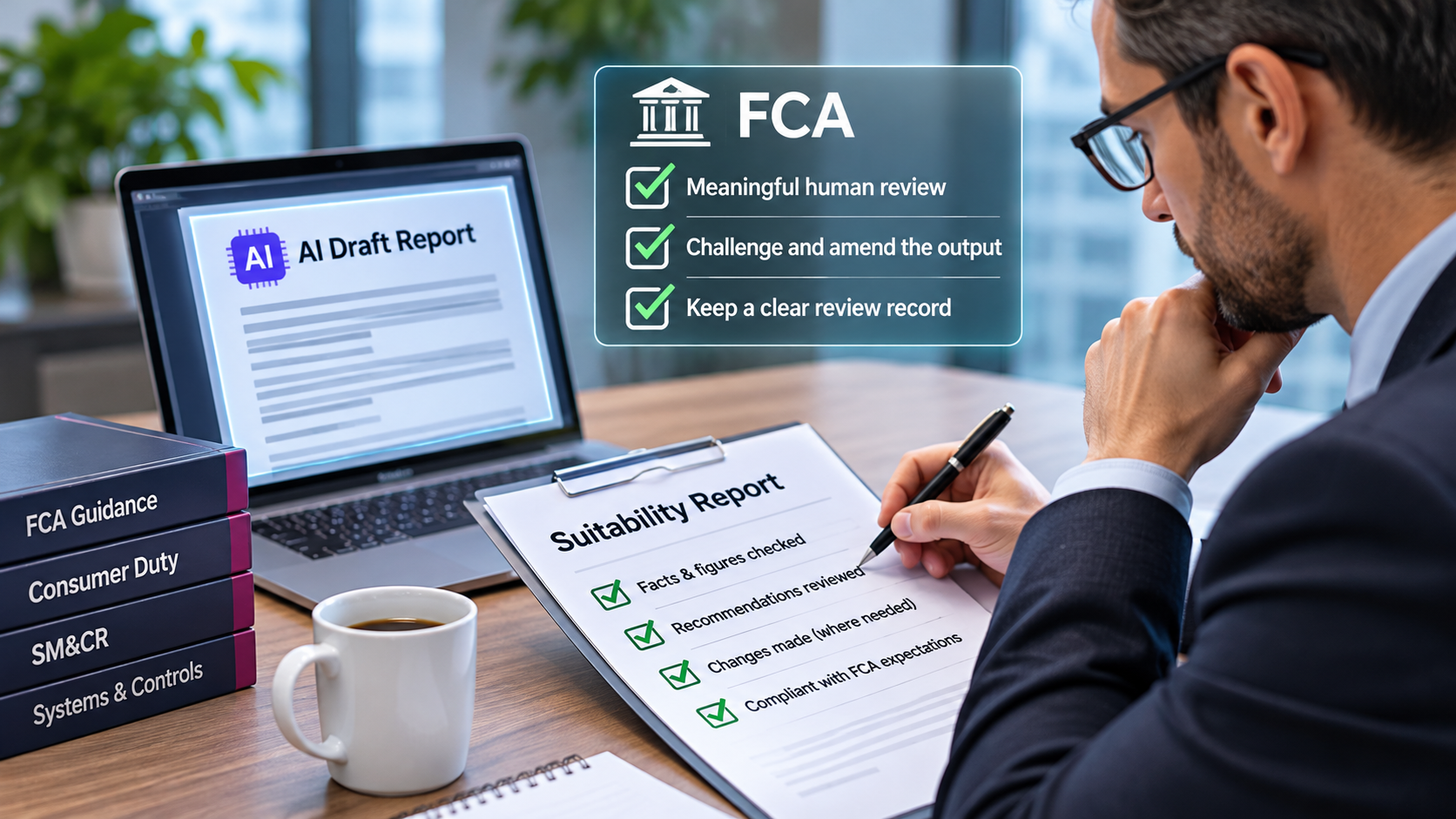
That’s the work technology should take on. The judgement about whether drawdown is right shouldn’t be handed to software. With good suitability report software, your firm’s approved drawdown template, with its sustainability section, decumulation risk wording and IHT paragraph, is applied the same way every time. It’s populated from the source documents your team already has, and the paraplanner reviews and edits the draft before it goes anywhere.
An AI suitability report generator built around your own templates can also help with the tax-year figures above. When an allowance changes, you update it once in the template rather than hunting through dozens of saved documents. That matters in a year with a Budget, the 2027 IHT change and the 2028 rise in the minimum pension age all affecting the same reports.
For teams with heavy volumes of reviews, AI for paraplanners works best when it takes on the repetitive drafting. That leaves the paraplanner more time to check the sustainability analysis and question weak reasoning. Specialist paraplanning software can also bring LOA data, transcripts and cashflow output into 1 structured draft instead of 5 separate files.
Any tool you use should sit within the FCA’s existing framework. The regulator hasn’t written separate AI rules, and accountability stays with your firm. Our guide to FCA expectations on AI in financial advice explains what that means in practice. If you need to make the case internally, our article on building a business case for AI in your advice firm shows how to measure the time and capacity involved. You can also compare options in our overview of AI software for financial advisers.
Frequently asked questions
Do you need a suitability report for drawdown?
Yes. Under COBS 9.4.1R, you must provide a suitability report when you make a personal recommendation to a retail client who then makes income withdrawals, takes an uncrystallised funds pension lump sum or buys a short-term annuity. The report must set out the client’s demands and needs, why the recommendation is suitable and any possible disadvantages.
What is a sustainable withdrawal rate for drawdown?
There’s no single figure the FCA endorses, and it varies with the client’s age, investment strategy, other income and how long the money needs to last. What the FCA does expect is that your method, whether cashflow modelling or a guide rate, is reasonable and clearly explained. TR24/1 criticised firms where it wasn’t clear how a guide rate had been decided.
How often should a drawdown plan be reviewed?
Currently, clients paying for an ongoing service should get the reviews they pay for, and most firms review drawdown at least once a year. The FCA’s CP26/10 proposals would move towards periodic reviews based on each client’s needs. For drawdown clients, many firms review more often after significant market falls or changes in the client’s circumstances.
What is sequencing risk and why does it matter in a drawdown report?
Sequencing risk is the extra damage caused when investment losses happen early in drawdown while withdrawals are still being taken. Selling units after a fall locks in losses and leaves less money to recover. A drawdown report should explain this in plain language and show how the investment strategy and fallback plan address it.
Does the April 2027 inheritance tax change affect drawdown advice?
Yes. For deaths on or after 6 April 2027, most unused pension funds and death benefits will be included in the estate for inheritance tax. That can change the order in which a client should draw from pensions and other assets. Drawdown reports should reflect it rather than relying on the old assumption that pensions pass on outside the estate.
See how Planbot handles your drawdown reports
If your drawdown reports are thorough but slow, or quick but thin in places, it’s worth looking at how the production side could work differently. Planbot’s AI report writing platform turns your firm’s own drawdown and review templates into AI-powered documents. Your paraplanners review and edit every report, and no client data is stored or used to train AI models.
Book a demo and see how your own drawdown template could work in Planbot.