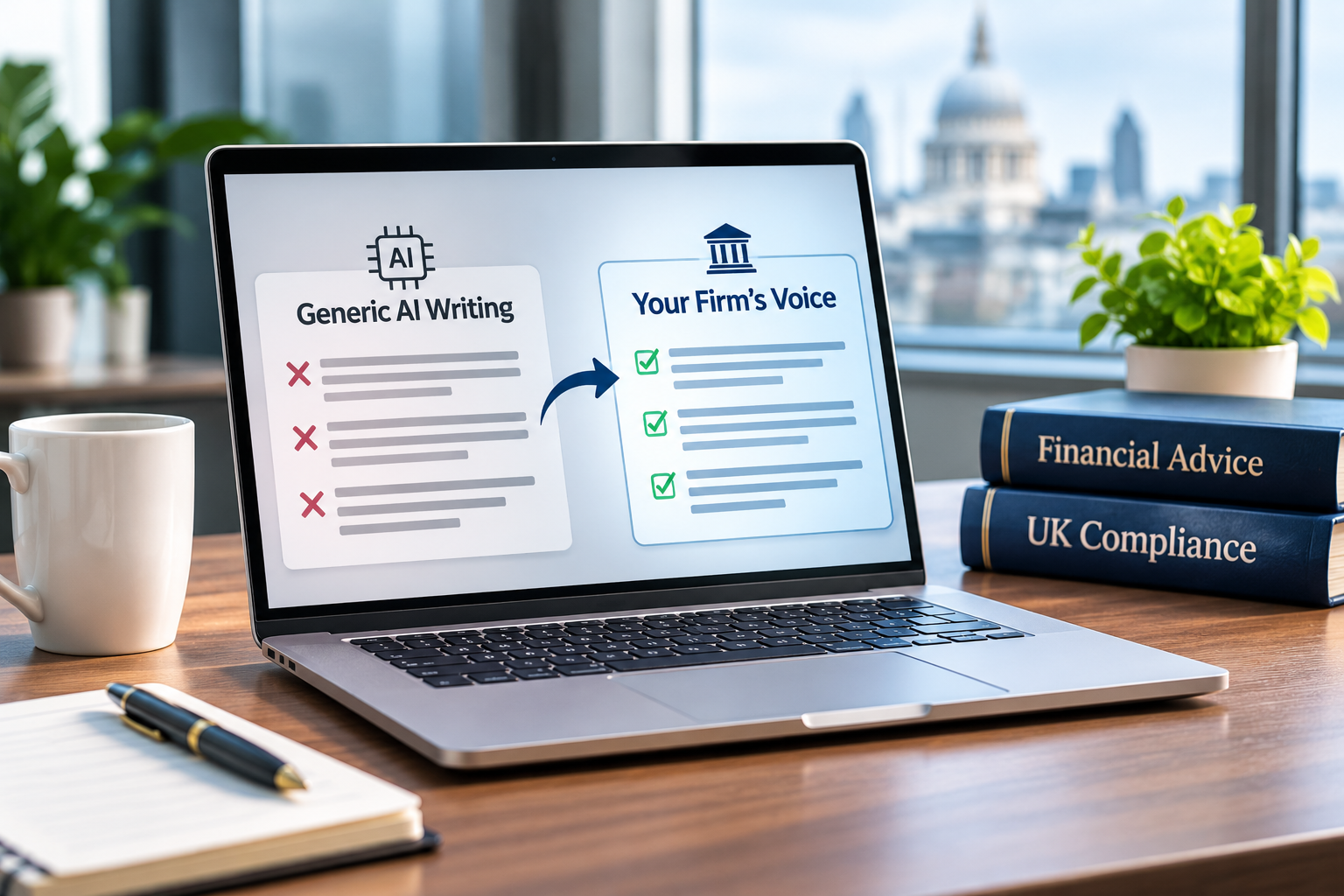
Controlled AI in financial advice means using artificial intelligence within a defined process where client information, report templates, approved wording and professional review remain under your firm’s control. Instead of allowing AI to make recommendations or generate unsupported conclusions, the technology supports tasks such as extracting information, populating documents and preparing draft explanations. Advisers and paraplanners retain responsibility for assessing suitability, checking accuracy and approving client communications. This approach can reduce administrative work, improve consistency and give your team more time to focus on clients without removing the professional judgement that regulated advice requires.
For many UK financial advice firms, suitability report writing remains a substantial part of the workload. Information must be gathered from fact finds, meeting notes, provider documents and research before it can be organised into a report.
Some of this work requires experience and technical knowledge. Other activities, such as transferring verified information between documents or applying consistent formatting, are largely repetitive.
AI can help with these tasks, but the way it is introduced matters.
A controlled workflow provides a clearer distinction between work that software can support and decisions that must remain with the professionals responsible for the advice.
AI Can Remove Work Without Removing Responsibility
AI can reduce the manual effort involved in preparing suitability reports, but it does not transfer responsibility for the advice to the technology provider. Your firm remains accountable for the suitability of its recommendations, the accuracy of client communications and the effectiveness of its controls. The appropriate objective is to automate suitable administrative activities while maintaining meaningful professional oversight.
Consider how a paraplanner might prepare a report following an annual financial review.
They may need to examine updated investment valuations, check the client’s recorded objectives, compare information from different documents and transfer relevant details into the firm’s reporting template.
Once this information is organised, they still need to consider the recommendation, identify any missing information and ensure the explanation accurately reflects the client’s circumstances.
AI can help with the earlier stages of this process.
For example, software may extract relevant information from source documents, organise meeting notes and populate sections of a report.
However, recognising that a client’s circumstances require a different investment approach involves more than transferring information.
That requires professional assessment.
Which tasks should AI support?
A useful way to approach automation is to separate repetitive document preparation from activities requiring judgement.
| Activity | Appropriate role for AI | Human responsibility |
| Extracting information | Identify relevant details from fact finds, statements and meeting notes | Confirm accuracy, relevance and currency |
| Populating report templates | Transfer information into the firm’s approved structure | Check completeness and correct placement |
| Preparing draft explanations | Help express adviser-approved reasoning clearly | Verify that the wording reflects the actual recommendation |
| Financial calculations | Support structured calculations using appropriate methods and verified inputs | Check assumptions, methodology and results |
| Applying standard wording | Insert approved content into relevant report sections | Confirm that the wording is appropriate and up to date |
| Assessing suitability | Organise evidence and highlight information requiring attention | Exercise professional judgement and reach the suitability conclusion |
| Final report approval | Support preparation, formatting and document review | Complete the firm’s required checks and authorise the document |
The purpose of automation should be to make the existing advice process more efficient, not to allow the technology to become an independent decision-maker.
What does the FCA expect when firms use AI?
The FCA has stated that it intends to rely on existing regulatory frameworks rather than introduce a separate set of AI-specific rules.
These include the Consumer Duty, the Senior Managers and Certification Regime and existing expectations for governance and controls.
Its approach to AI in financial services makes clear that innovation should be supported by appropriate accountability.
For financial advice firms, this means AI use should fit within established arrangements for supervision, risk management and client communication.
A report produced using AI must still satisfy the relevant regulatory requirements.
The technology used to prepare the document does not change the firm’s obligations.
What a Controlled Workflow Looks Like: Approved Inputs, Structured Data, Approved Templates and Human Review
A controlled AI reporting workflow starts with reliable source information, organises that information into a defined structure and uses approved templates to prepare the document. AI assists with specific drafting and administrative tasks, while important figures, standard wording and recommendation-specific explanations remain subject to appropriate controls. A qualified professional then reviews the report before it is issued.
This approach is different from uploading several documents into a general-purpose chatbot and asking it to write a complete suitability report.
With an unrestricted prompt, the AI may be expected to decide which information matters, determine the structure and produce the explanation.
A controlled workflow makes those decisions more deliberate.
1. Start with approved source information
The quality of a suitability report depends on the information used to prepare it.
For example, imagine you are preparing a retirement planning recommendation for a client aged 59.
Your source documents include a current fact find, pension statements, meeting notes, risk assessment and details of the proposed recommendation.
Before using AI, you should establish whether the information is sufficiently complete and current.
If the fact find shows a pension value of £375,000 but a more recent provider statement records £362,000, the discrepancy should be resolved.
AI may help identify the 2 figures, but it should not independently decide which one is correct without an appropriate basis.
The same principle applies to income requirements, expenditure, investment objectives and other information that influences the recommendation.
2. Structure the information before generating explanations
Once the relevant information has been identified, it can be organised into defined categories.
These might include:
- Client Circumstances: Income, Expenditure, Assets, Liabilities And Relevant Personal Information.
- Financial Objectives: The Outcomes The Client Wants To Achieve And Their Intended Timescales.
- Risk Assessment: Attitude To Risk, Capacity For Loss And Relevant Investment Experience.
- Existing Arrangements: Current Products, Charges, Benefits And Important Features.
- Proposed Recommendation: The Adviser-Approved Course Of Action And Supporting Rationale.
- Supporting Evidence: Research, Calculations, Product Information And Relevant Meeting Records.
This structure helps separate known facts from the conclusions drawn during the advice process.
It also makes missing information easier to identify.
For example, if the report requires an explanation of the client’s capacity for loss but the relevant assessment is incomplete, the issue should be highlighted rather than filled with a generic statement.
3. Use approved report templates
Your firm’s templates contain more than formatting preferences.
They may reflect years of experience in explaining recommendations, presenting information and meeting internal compliance standards.
A controlled reporting process should preserve the relevant sections, approved disclosures, terminology and presentation.
Purpose-built suitability report software can support this approach.
Ammonite’s Planbot, for example, is designed to transform existing financial advice document templates into AI-assisted workflows.
It can work with information from PDFs, Word documents, spreadsheets, CSV files and meeting transcripts to help populate reports.
Your firm controls the wording, sections, tone and styling, while the resulting documents remain editable before finalisation.
That provides a more structured starting point than asking each paraplanner to reproduce the firm’s reporting standards through individual AI prompts.
4. Apply human review before issuing the document
Review should go beyond checking whether the report reads well.
You need to confirm that the information accurately reflects the client file and that the explanation supports the actual recommendation.
For example, if the report states that a particular investment strategy is consistent with the client’s objectives, the reviewer should understand the evidence behind that conclusion.
If it contains a financial figure, the source or calculation should be identifiable.
Where risks or disadvantages are relevant, they should be explained accurately rather than shortened for convenience.
A controlled workflow should make these checks part of the process rather than treating them as optional proofreading.
Where Professional Judgement Stays With the Adviser: Suitability, Challenge and Client Outcomes
Professional judgement must remain central to decisions about suitability, the interpretation of client circumstances and the recommendations made. AI can organise evidence and help explain decisions, but it should not independently determine whether advice is appropriate. Advisers and paraplanners need to assess the available information, challenge unsupported assumptions and consider how recommendations could affect the client’s financial outcomes.
This distinction becomes particularly important when a recommendation involves competing priorities.
Imagine a client who wants to increase their retirement income while preserving capital for their family.
They may have a relatively high tolerance for investment risk but limited capacity to absorb significant financial losses.
Those circumstances require careful consideration.
An AI-generated explanation might focus on the client’s willingness to accept volatility while giving insufficient attention to the financial consequences of a substantial loss.
A professional adviser must consider the relevant circumstances together rather than treating the risk questionnaire as the only basis for a recommendation.
Why suitability cannot be reduced to a standard template
A template provides structure, but it cannot determine the correct recommendation for an individual client.
The suitability of advice may depend on factors such as:
- Financial Objectives: What The Client Wants To Achieve And When.
- Capacity For Loss: The Financial Consequences Of Investment Losses.
- Investment Experience: The Client’s Understanding Of Relevant Products And Risks.
- Access Requirements: Whether The Client May Need Their Capital Within A Particular Period.
- Existing Benefits: Guarantees, Protections Or Other Features That Could Be Lost.
- Personal Circumstances: Relevant Family, Employment, Health Or Retirement Considerations.
These factors may interact in complicated ways.
A recommendation that is appropriate for one client may not be suitable for another with similar savings but different income needs or financial commitments.
AI can assist with organising the information, but the professional assessment must remain with the firm.
The importance of challenging the draft
A strong review process should encourage advisers and paraplanners to question what the draft says.
Suppose a report explains that consolidating pension arrangements will simplify administration and improve oversight.
Those may be legitimate potential benefits.
However, the adviser must also consider whether consolidation could involve higher charges, the loss of valuable benefits or other disadvantages.
If the generated explanation discusses only the benefits, the reviewer should challenge it.
The FCA’s suitability report requirements under COBS 9.4 include explaining why a recommended transaction is suitable and any possible disadvantages, where those rules apply.
Other requirements may apply depending on the type of advice and product involved.
The review process therefore needs to examine the substance of the document, not simply its presentation.
Consumer Duty and better client understanding
The Consumer Duty also reinforces the importance of considering the client’s experience of financial services.
For firms within its scope, the Duty includes expectations concerning consumer understanding and customer outcomes.
A technically accurate suitability report is not necessarily effective if the client cannot understand the explanation.
For example, an adviser may need to spend additional time explaining investment risk to someone with limited financial experience.
Another client may prefer a more detailed technical explanation.
Controlled AI should support these differences.
It should help your firm communicate more consistently without forcing every client into identical wording.
Improving Consistency Across the Firm and Changing the Process Centrally When Requirements Change
Central control over templates, terminology and approved wording can help your firm produce more consistent suitability reports across different advisers and paraplanners. It also makes changes easier to manage. Rather than asking individual employees to update their own prompts and documents, your business can maintain common reporting standards and introduce revisions through a defined approval process.
This becomes increasingly valuable as teams grow.
A firm with 2 paraplanners may find it relatively straightforward to maintain consistent reports through regular discussions.
For a business with 15 paraplanners working across several advisory teams, the challenge is different.
Employees may have varying levels of experience, use different document templates or develop personal approaches to drafting.
Without central standards, reports can gradually become inconsistent.
Why individual AI processes can create problems
Consider a firm where several paraplanners use general-purpose AI assistants.
One employee uses a detailed prompt that includes the firm’s preferred tone.
Another has saved standard paragraphs in a personal document.
A third uses an older version of the firm’s report template.
Each employee may produce satisfactory work, but maintaining consistent standards becomes more difficult.
If the compliance team approves a new explanation of ongoing service charges, the update needs to reach every relevant employee and document.
There is also a risk that outdated wording will remain in saved prompts or previous examples.
A centrally managed approach reduces that dependency on individual working habits.
Making approved changes without rebuilding the workflow
A controlled reporting system should allow your firm to revise templates, wording and formatting as its requirements develop.
For example, you might want to improve the way a report explains the impact of investment charges.
Your compliance team reviews the proposed wording and approves an updated version.
The firm can then introduce the change into the relevant templates and communicate when it should be used.
This does not mean that the same explanation will suit every recommendation.
It means employees begin with approved wording and adapt the document where the individual circumstances require it.
Planbot is designed to give firms control over their report templates, including the ability to make ongoing changes to wording, structure and presentation.
This is useful when your firm wants to maintain consistent standards without depending on a technology provider to complete every routine template amendment.
The Practical Benefits: Less Administration, More Client Time and Better Tools for Paraplanners
The main benefit of controlled AI is the opportunity to reduce repetitive document preparation while preserving professional oversight. Advisers and paraplanners can spend less time transferring information, formatting reports and rewriting standard explanations. The time released can then be used for reviewing recommendations, resolving complex cases, supporting clients and improving the quality of the advice process.
The benefits should be assessed realistically.
Introducing AI does not mean every report will take the same amount of time or that complex cases will suddenly become straightforward.
Some recommendations require extensive research, additional technical checks and careful client communication.
A well-designed process should make these activities easier to manage, not remove them.
Reducing repetitive preparation work
Suitability report production often involves tasks that add relatively little professional value but consume a considerable amount of time.
These include copying information from fact finds, organising provider details, formatting tables and ensuring that standard sections follow the firm’s preferred layout.
AI-assisted document software can help reduce this work.
Ammonite reports that Planbot can increase capacity for complex suitability reports by approximately 2 to 3 times, with larger capacity improvements claimed for certain other document types.
These are Ammonite’s stated performance figures rather than guaranteed results for every advice firm.
Actual time savings will depend on the complexity of your reports, the quality of source information, your templates and the amount of review required.
The more useful measure is whether the overall process becomes more efficient without compromising standards.
Giving paraplanners more time for technical work
Paraplanners bring valuable experience to the advice process.
Their contribution includes interpreting financial information, identifying potential issues and helping advisers explain recommendations accurately.
When too much time is spent on routine document preparation, there may be less capacity for these activities.
Appropriate paraplanning software can help by supporting the administrative stages of report production.
That may allow paraplanners to concentrate on reviewing technical details, checking calculations and identifying inconsistencies in client information.
It can also reduce the pressure associated with preparing lengthy reports during particularly busy periods.
Improving the client experience
Efficiency can benefit clients when it supports more timely communication and gives advisers greater capacity to respond to their needs.
For example, if your team can prepare the first draft of a suitability report more efficiently, there may be more time available to review the explanation before the client receives it.
Advisers may also have greater capacity for follow-up conversations and answering questions.
However, faster production should not become the sole measure of success.
The report still needs to explain the recommendation clearly, address relevant risks and reflect the client’s circumstances.
A useful AI workflow should support those outcomes rather than encouraging speed at the expense of accuracy.
How to Introduce Controlled AI Into Your Advice Firm
Moving towards controlled AI does not necessarily require a complete redesign of your firm’s existing processes.
A more practical starting point is to identify where the greatest amount of repetitive work occurs and establish which activities could be supported safely.
You can then evaluate whether available technology meets your reporting, security and governance requirements.
Start with a limited pilot
Choose a manageable group of report types and a small number of experienced employees.
For example, you might begin with straightforward suitability reports or annual review letters where the firm already has well-established templates.
During the pilot, assess how the software handles source information, document formatting and standard wording.
You should also examine the quality of the resulting drafts and the amount of professional review required.
Measure the whole reporting process
It is tempting to measure AI performance by how quickly the first draft appears.
However, this can give a misleading impression of efficiency.
A report generated in 5 minutes is not necessarily a time saving if it requires several hours of corrections.
A better evaluation considers:
- Preparation Time: How Long It Takes To Gather Information And Create The Initial Draft.
- Review Time: How Much Professional Checking And Editing Is Required.
- Error Rates: How Often Incorrect Figures, Missing Information Or Unsupported Statements Are Identified.
- Template Consistency: Whether Reports Follow The Firm’s Approved Structure And Wording.
- Staff Experience: Whether The Technology Makes Day-To-Day Work Easier.
- Client Communication: Whether Reports Remain Clear, Relevant And Appropriate For Their Intended Audience.
It is worth comparing these measures with your existing process rather than assuming that any reduction in drafting time represents a meaningful improvement.
Establish ownership and ongoing review
Your firm should decide who is responsible for managing the reporting workflow.
This may involve representatives from compliance, paraplanning, advice management and technology.
Their responsibilities might include approving templates, reviewing system changes, arranging staff training and monitoring how the software is used.
It is also sensible to establish a process for reporting errors and improving the workflow.
If paraplanners repeatedly identify the same problem, that information should be used to refine the process rather than leaving employees to make the same correction indefinitely.
Over time, this can help your firm develop a more consistent and reliable approach to AI-supported document production.
A Better-Equipped Adviser Is Still the Adviser
The future of AI in financial advice should not depend on removing people from the process.
Advisers and paraplanners remain essential because financial advice involves interpretation, judgement and an understanding of individual circumstances.
Technology can make supporting activities easier, particularly where information needs to be gathered from different documents and presented in a consistent format.
However, the suitability of a recommendation cannot be established simply because software has produced a persuasive explanation.
Your firm needs to know that the underlying information is correct, the risks have been considered and the document accurately communicates the advice.
Controlled AI provides a framework for making that distinction.
By combining approved inputs, structured information, established templates and professional review, financial advice firms can use AI more deliberately.
This can support consistent reporting standards while giving employees greater capacity for the work that requires their expertise.
The result should be a better-equipped adviser and paraplanning team, rather than a reporting process that depends on software making decisions it was never intended to make.
Explore Controlled AI Suitability Reporting With Ammonite AI
Ammonite AI has developed Planbot for UK financial advice firms that want to make suitability report production more efficient while maintaining control over their documents.
Built by professionals with experience in financial advice and paraplanning, Planbot works with your existing templates and helps turn source information into structured, editable reports.
Your team can control the wording, sections, formatting and presentation, while retaining responsibility for reviewing the content and approving the finished document.
Rather than replacing the expertise of advisers and paraplanners, Planbot is designed to support the work they already do.
Book a Planbot demo to explore how a controlled AI reporting workflow could help your firm reduce administrative work, maintain consistent documentation and give your team more time to focus on clients.